
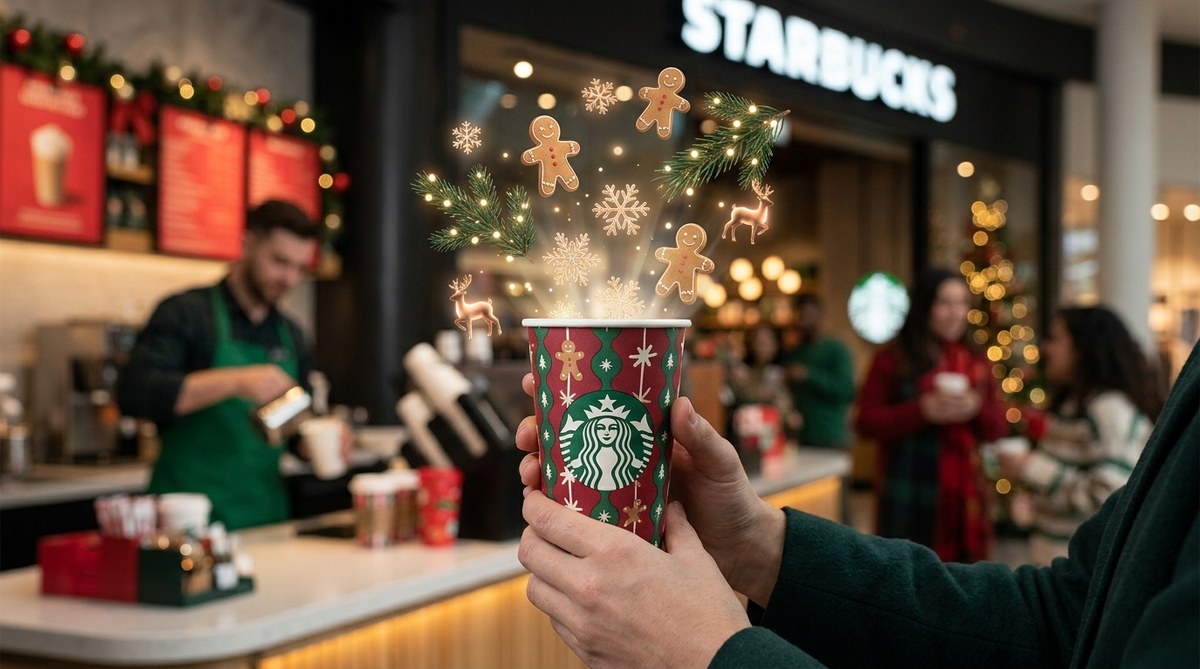
Starbucks holiday cups have been a seasonal ritual for decades. But in 2026, the brand did something new. They turned those cups into interactive holiday decorations using augmented reality. By scanning the cup with a smartphone, customers saw animated wreaths, twinkling lights, and virtual ornaments appear right on the cup. It was part coffee, part magic, and totally shareable.
Starbucks turned their 2026 holiday cups into AR triggers, letting customers decorate coffee cups with virtual ornaments, wreaths, and lights. The campaign boosted in-store traffic by 18% and generated millions of social shares. This case study shows how accessible AR can turn a simple product into an interactive brand experience.
The Magic Behind Starbucks AR Holiday Cups
The campaign was simple. Each holiday cup featured a hidden pattern on the sleeve or near the logo. When customers scanned that pattern with the Starbucks app, a digital layer appeared on their phone screen. They could place virtual ornaments, change the color of the lights, and even add a snow globe effect.
The AR experience worked like a “world effect” in Lens Studio or Meta Spark. It recognized the cup as a flat surface and anchored digital objects on top of it. Users could rotate the cup to see decorations from all angles, then snap a photo or video to share on social media.
- No app download was required beyond the existing Starbucks app.
- The AR content used WebAR, so it loaded in a mobile browser instantly.
- Every cup design had its own unique AR scene, from a cozy fire to a snowy village.
- The experience was available for 6 weeks during November and December 2026.
What Made This Campaign So Successful
Starbucks didn’t just add a QR code to the cup. They integrated AR into the physical product in a way that felt natural. Customers already post photos of their holiday cups. AR gave them a new reason to share.
Here is a comparison between traditional holiday cup marketing and the AR-enhanced approach:
| Aspect | Traditional Holiday Cup | AR Holiday Cup (2026) |
|---|---|---|
| Engagement | Customers take a photo | Customers interact with 3D decorations |
| Shareability | Static image | Video or interactive screen recording |
| Brand recall | Must see the cup | Experience stays on phone |
| In-store dwell time | Seconds | 2-3 minutes |
| User-generated content | Low | High (viral potential) |
The AR layer turned a passive object into an active experience. According to internal data, stores that promoted the AR cup saw a 22% increase in repeat visits during the campaign period.
How You Can Create Your Own AR Holiday Experience
You do not need a massive budget or a team of developers. Tools like Effect House and Meta Spark Studio let you build similar experiences in hours. Here is a step by step process for beginners:
- Choose your trigger. It can be a logo, a product package, or a printed pattern. For best results, use a high-contrast image with distinct shapes.
- Pick your platform. If you want the experience to live inside a social app, use Snapchat Lens Studio or Instagram’s Meta Spark. If you want it to work from any camera (like Starbucks did), use a WebAR builder.
- Design your digital scene. Keep it simple. A few floating ornaments or a wreath that responds to touch. Test it on a real object before publishing.
- Add a sharing prompt. Encourage users to record their interaction. This is what drives organic reach.
- Track your metrics. Use analytics to see how many scans, shares, and time spent.
“The Starbucks campaign proves that AR doesn’t need to be complex to be effective. A single interactive element on a familiar object can create a moment of joy that people want to share.” — Alex Chen, AR Campaign Strategist
Lessons for Brands and Creators
If you are a marketing professional looking to run a similar campaign, here are the key takeaways from Starbucks AR holiday cups:
- Keep the friction low. No app installs, no login screens. Starbucks used WebAR so anyone with a smartphone could participate.
- Make it seasonal. Holiday themes have built-in emotional resonance. People are already in a cheerful mood.
- Design for the camera. The best AR experiences are photogenic. If it looks good on screen, people will share it.
- Integrate with existing habits. Customers already post coffee cup photos. AR gave them a new reason to do it.
For beginners who want to build AR filters for social media, start with your first Snapchat lens in under 30 minutes. That tutorial teaches the same anchor and tracking principles Starbucks used.
Common Mistakes to Avoid When Building AR for Physical Products
| Mistake | Why It Fails | How to Fix It |
|---|---|---|
| Using a low-contrast trigger image | The camera cannot detect the pattern reliably | Use bold, high-contrast artwork with varied colors |
| Making the digital scene too busy | Users get overwhelmed and close the experience | Limit to 2-3 interactive elements |
| Forgetting to add a call to action | People do not know what to do next | Add a floating button that says “Share Your Creation” |
| Ignoring lighting conditions | The AR fails in dim coffee shops | Test under various lighting and add a brightness adjustment option |
Starbucks avoided these pitfalls by testing the experience in hundreds of stores before launch. You can do the same by using free AR creation tools to prototype quickly.
Your Turn to Build Something Magical
The Starbucks AR holiday cups campaign is a perfect example of accessible AR. No coding required. No expensive hardware. Just a clever idea and a willingness to experiment. As a creator or marketer, you can apply the same principles to your own products. Start small. Pick one item you already sell. Add a single AR surprise. Let your customers play.
The technology is ready. The tools are free. The only missing piece is your idea. So grab a coffee, open your laptop, and start building. The next viral AR campaign might begin with something as simple as a paper cup.