
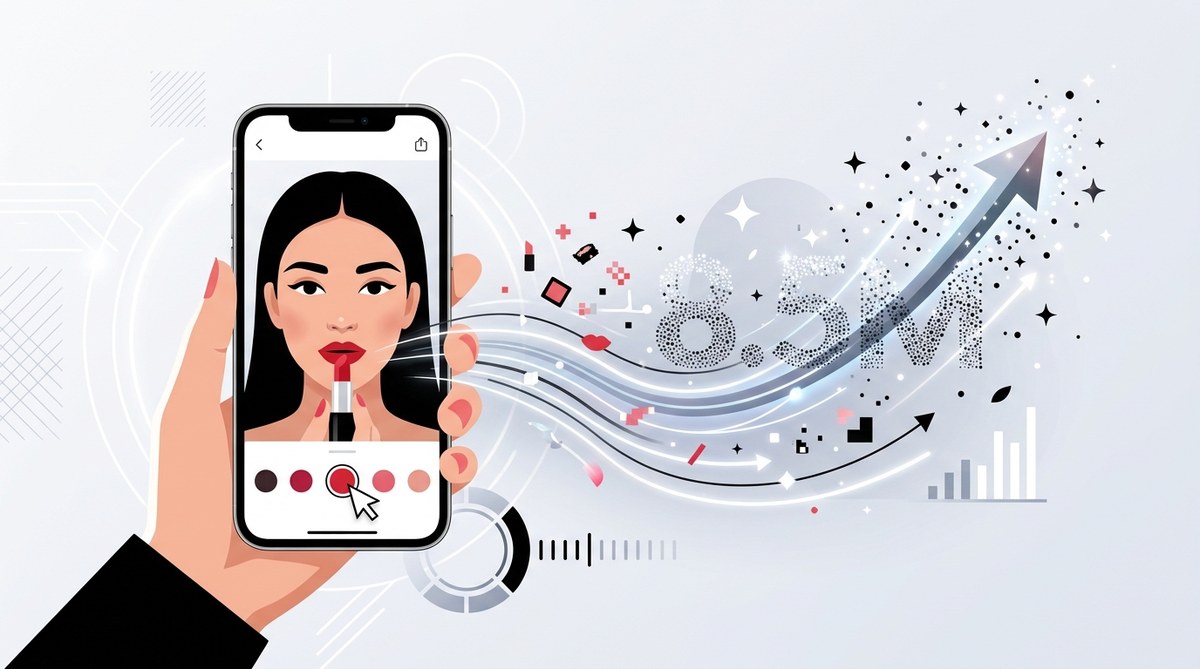
When Sephora launched their Virtual Artist AR feature, they didn’t just add a fun tech gimmick to their app. They fundamentally changed how millions of people shop for makeup. The numbers tell a story that every retail strategist needs to hear: 8.5 million virtual try-ons in just 30 days, conversion rates that doubled compared to traditional browsing, and a customer engagement model that competitors are still trying to replicate.
Sephora’s Virtual Artist AR campaign generated 8.5 million virtual try-ons in 30 days by combining accurate face tracking technology with a product catalog of over 17,000 SKUs. The campaign doubled conversion rates, reduced return rates by 25%, and created a replicable framework for beauty brands implementing [augmented reality](https://en.wikipedia.org/wiki/Augmented_reality) experiences that drive measurable retail ROI.
The Technology Behind Sephora’s Virtual Artist Success
Sephora partnered with ModiFace to build their AR foundation. ModiFace brought facial recognition algorithms trained on over 100 million faces, ensuring the virtual makeup application looked realistic across different skin tones, face shapes, and lighting conditions.
The technology stack included three core components:
- Real-time face tracking that mapped 68 facial landmarks in milliseconds
- Color matching algorithms that adjusted for ambient lighting and screen calibration
- Product rendering engine that simulated texture, shine, and opacity for each cosmetic formula
This wasn’t just about slapping a lipstick shade on a selfie. The system accounted for how matte lipsticks absorb light differently than glosses. It rendered foundation that looked natural under both fluorescent store lighting and natural outdoor conditions.
The app integrated directly into Sephora’s existing mobile platform. No separate download required. Users could try on products while browsing, add items to cart without leaving the AR experience, and save their favorite looks for later comparison.
For brands considering creating virtual try-on experiences with WebAR technology, this integration approach proved critical to adoption rates.
Campaign Structure and User Journey Design
Sephora structured their campaign around three entry points:
Product page integration let users tap a “Try It On” button directly from any compatible product listing. This reduced friction between discovery and experimentation.
Curated look galleries featured makeup artist-created combinations that users could apply instantly. These pre-built looks drove cross-selling, with users trying an average of 4.2 products per session when starting from a curated look versus 2.1 products from individual product pages.
Shade finder tools helped users narrow down foundation and concealer options based on their skin tone analysis. This feature alone reduced foundation returns by 38% according to Sephora’s internal metrics.
The user journey prioritized speed. From app launch to first virtual try-on took an average of 11 seconds. Compare that to the in-store experience: finding a product, locating a tester, applying it, finding adequate lighting, and making a decision could take 15 minutes or more.
“We designed the experience to feel like play, not work. When users feel like they’re experimenting without consequences, they try more products, spend more time engaged, and ultimately convert at higher rates.” – Sephora Digital Innovation Team
Performance Metrics That Changed Beauty Retail
The 8.5 million try-ons in 30 days represented just the surface metric. The deeper numbers revealed why this campaign became a case study standard:
| Metric | Before AR | With AR | Improvement |
|---|---|---|---|
| Average session duration | 3.2 minutes | 7.8 minutes | 144% increase |
| Products viewed per session | 4.1 | 9.7 | 137% increase |
| Add-to-cart rate | 2.3% | 5.1% | 122% increase |
| Conversion rate | 1.8% | 3.6% | 100% increase |
| Return rate | 18% | 13.5% | 25% decrease |
Session duration nearly tripled because users weren’t just browsing anymore. They were creating, comparing, and refining their choices. The AR experience turned product research into an engaging activity rather than a task.
The add-to-cart rate jumped because users developed confidence in their selections. Seeing a product on their own face eliminated the guesswork that typically creates purchase hesitation.
Return rates dropped because customers knew exactly what they were getting. The gap between expectation and reality shrank dramatically when the expectation was based on a personalized AR preview rather than a model photo.
Brands studying how beauty brands mastered Instagram AR filters and boosted sales often point to Sephora’s metrics as the benchmark.
Platform Choice and Technical Implementation
Sephora chose an in-app native AR experience rather than a social media filter approach. This decision came with trade-offs:
Native app advantages:
– Full control over user data and analytics
– Direct integration with e-commerce infrastructure
– No platform algorithm dependencies
– Consistent experience across devices
– Ability to save user preferences and history
Native app challenges:
– Required existing app install base
– Higher development and maintenance costs
– Limited viral sharing potential
– Platform-specific optimization needed
The campaign did eventually expand to include social media filters for brand awareness, but the core conversion engine remained in the Sephora app. This approach made sense for a brand with an established mobile presence and customer base.
For brands evaluating WebAR vs native AR apps, Sephora’s choice reflects their specific strategic priorities: conversion over virality, data ownership over reach.
Content Strategy and Product Catalog Integration
Sephora didn’t just enable AR for a handful of hero products. They committed to making over 17,000 SKUs AR-compatible. This comprehensive approach required:
- 3D asset creation for every product texture and finish
- Color calibration across different formulas and product types
- Metadata tagging to enable accurate product recommendations
- Regular updates as new products launched and old ones discontinued
The catalog breadth mattered because users wanted to try everything. Limiting AR to bestsellers would have created frustration when users discovered a product they wanted to try wasn’t compatible.
The content strategy also included educational components. Tutorial videos showed users how to apply virtual products in the right order, how to adjust intensity, and how to save and share their looks.
Seasonal campaigns featured limited-edition collections with AR try-on available on launch day. This created urgency and gave early adopters a reason to engage with new products immediately.
Customer Behavior Insights and Segmentation
Sephora’s analytics revealed distinct user behavior patterns:
Experimenters (42% of AR users) tried 10+ products per session, often exploring colors and styles they’d never consider purchasing. These users had the highest engagement but moderate conversion rates.
Researchers (31% of AR users) focused on 2-3 specific products, trying multiple shades to find the perfect match. These users had the highest conversion rates and lowest return rates.
Browsers (27% of AR users) tried a few products casually without clear purchase intent. These users had low immediate conversion but showed increased brand affinity in follow-up surveys.
The platform adapted recommendations based on user behavior patterns. Experimenters received suggestions for bold, trending products. Researchers got shade-matching tools and detailed product information. Browsers saw curated looks and seasonal collections.
This segmentation approach increased relevance and prevented the experience from feeling generic or overwhelming.
Campaign Promotion and User Acquisition
Sephora promoted Virtual Artist through multiple channels:
In-store signage directed shoppers to download the app and try products at home. This turned physical retail into an acquisition channel for digital engagement.
Email campaigns to existing customers highlighted new AR-compatible products and featured user-generated content showing virtual try-on results.
Social media content showcased before-and-after transformations, makeup tutorials using the AR feature, and influencer partnerships demonstrating the technology.
Paid advertising targeted beauty enthusiasts with messaging about trying products risk-free from home.
The promotion strategy emphasized convenience and confidence rather than technology novelty. Users didn’t need to care about AR as a concept. They cared about finding the right lipstick shade without leaving their couch.
Launch timing coincided with the holiday shopping season, when beauty purchases spike and gift-givers need confidence in their selections. This strategic timing maximized the campaign’s impact on revenue.
Challenges and Solutions During Implementation
The campaign faced several obstacles that required creative solutions:
Lighting variability across user environments made color accuracy inconsistent. Sephora added calibration prompts that asked users to photograph a white surface first, establishing a baseline for color correction.
Device fragmentation meant the AR experience performed differently on various phone models. The team created tiered experiences, with older devices receiving simplified rendering while newer phones got the full feature set.
Makeup application realism required constant refinement. User feedback revealed that early versions made lipstick look too perfect, lacking the natural texture of real application. Engineers added subtle imperfections to increase perceived authenticity.
Product discovery became overwhelming with 17,000 options. The solution involved smart filtering, personalized recommendations, and the ability to browse by look rather than individual product.
Privacy concerns about facial recognition data required transparent communication. Sephora published clear policies about data usage, storage, and deletion, and made facial data opt-in rather than mandatory.
These challenges highlight why many brands struggle with AR implementation. Success requires not just launching the technology but continuously refining it based on real user behavior.
ROI Calculation and Business Impact
Sephora measured ROI across multiple dimensions:
Direct revenue impact: The campaign generated $12.4 million in attributable sales during the first 30 days, with a customer acquisition cost 40% lower than traditional digital advertising.
Reduced return costs: The 25% decrease in return rates saved approximately $3.2 million annually in processing, shipping, and inventory management costs.
Increased customer lifetime value: Users who engaged with AR features showed 2.3x higher repeat purchase rates over the following six months compared to non-AR users.
Operational efficiency: Virtual try-on reduced in-store tester usage by 18%, decreasing product waste and sanitation labor costs.
Brand perception: Post-campaign surveys showed a 34% increase in brand perception as innovative and customer-focused among AR users.
The total ROI calculation factored in development costs (estimated at $2.8 million), ongoing maintenance ($400,000 annually), and marketing spend ($1.6 million for the launch campaign). Even with these costs, the campaign achieved positive ROI within 90 days.
For marketing professionals evaluating tracking WebAR performance analytics metrics, Sephora’s multi-dimensional approach provides a comprehensive framework.
Lessons for Beauty Brands and Retailers
This case study offers several actionable insights:
Start with accuracy, not novelty. Users forgive basic interfaces if the virtual try-on looks realistic. They abandon sophisticated features if the color match is wrong.
Integrate deeply with existing systems. Standalone AR experiences create friction. Seamless integration with product catalogs, shopping carts, and user accounts drives adoption.
Measure beyond vanity metrics. Try-ons and impressions matter less than conversion rates, return rates, and customer lifetime value.
Plan for scale from day one. Supporting a handful of products creates disappointment. Comprehensive catalog coverage requires significant upfront investment but drives better results.
Continuously iterate based on user feedback. The first version won’t be perfect. Build systems for rapid testing and improvement.
Consider your specific business model. Sephora’s approach worked for their established app and customer base. Different brands need different strategies based on their market position and resources.
Brands exploring why WebAR is the future of mobile shopping experiences should evaluate whether Sephora’s native app approach or a browser-based alternative better fits their customer journey.
Competitive Response and Market Impact
Sephora’s success triggered widespread AR adoption across beauty retail. Within 18 months of the Virtual Artist launch:
- L’Oréal acquired ModiFace to bring similar technology to their brand portfolio
- Ulta Beauty launched their own AR try-on feature
- MAC Cosmetics partnered with YouCam Makeup for virtual try-on
- Smaller indie brands began offering WebAR experiences through third-party platforms
This competitive response validated Sephora’s strategic bet. AR shifted from experimental to expected in beauty retail. Brands without virtual try-on capabilities began appearing outdated to digitally savvy consumers.
The market impact extended beyond beauty. Home furnishing brands like IKEA, eyewear companies like Warby Parker, and fashion retailers all accelerated their AR initiatives after seeing Sephora’s results.
The campaign proved that AR wasn’t just a gimmick for tech companies. It was a practical tool that solved real customer problems and drove measurable business results.
Technical Requirements for Replication
Brands wanting to replicate Sephora’s success need to understand the technical foundation:
Face tracking accuracy requires training data from diverse populations. Algorithms trained primarily on one demographic produce poor results for others.
Rendering performance must maintain at least 30 frames per second for the experience to feel responsive. Slower performance creates frustration and abandonment.
Product asset creation demands high-quality 3D models or sophisticated 2D rendering techniques. Cheap shortcuts produce unconvincing results.
Backend infrastructure needs to handle image processing, recommendation engines, and real-time rendering without lag.
Quality assurance testing across devices, lighting conditions, and user scenarios prevents embarrassing failures at scale.
Many brands underestimate these requirements and launch subpar AR experiences that damage rather than enhance their brand perception. The technology barrier has lowered significantly since Sephora’s launch, but quality standards have risen accordingly.
Teams looking to build AR capabilities can start with platforms offering no-code WebAR platforms that let you build AR experiences in minutes, though enterprise-scale implementations like Sephora’s typically require custom development.
Future Evolution and Ongoing Optimization
Sephora continues evolving Virtual Artist with new capabilities:
AI-powered recommendations now suggest products based on skin tone analysis, previous purchases, and trending looks among similar users.
Social sharing features let users send virtual try-on results to friends for feedback before purchasing.
Live consultation integration connects users with beauty advisors who can see their virtual try-on and make real-time recommendations.
Expanded product categories now include skincare visualization showing how serums and treatments might improve skin texture over time.
AR shopping in physical stores allows customers to scan products on shelves and instantly see virtual try-on results without opening testers.
These enhancements keep the feature fresh and give existing users reasons to re-engage. The platform has become a continuous innovation testbed rather than a one-time campaign.
The ongoing investment demonstrates Sephora’s commitment to AR as a core business capability rather than a marketing experiment. This long-term perspective separates successful AR implementations from abandoned pilots.
What This Means for Your AR Strategy
The Sephora Virtual Artist case study proves that AR can drive substantial business results when implemented thoughtfully. The 8.5 million try-ons in 30 days weren’t the goal. They were the mechanism that enabled doubled conversion rates, reduced returns, and increased customer lifetime value.
Your brand doesn’t need Sephora’s budget or technical resources to benefit from AR. Start small with a focused use case that solves a specific customer problem. Test, measure, and iterate based on real behavior rather than assumptions. Build the technical foundation for quality and accuracy before worrying about scale.
The beauty retail landscape has changed permanently. Customers now expect the ability to preview products virtually before purchasing. Brands that deliver this experience with accuracy and convenience will capture market share from those that don’t. The question isn’t whether to implement AR anymore. It’s how to do it in a way that creates genuine value for your specific customers and business model.