
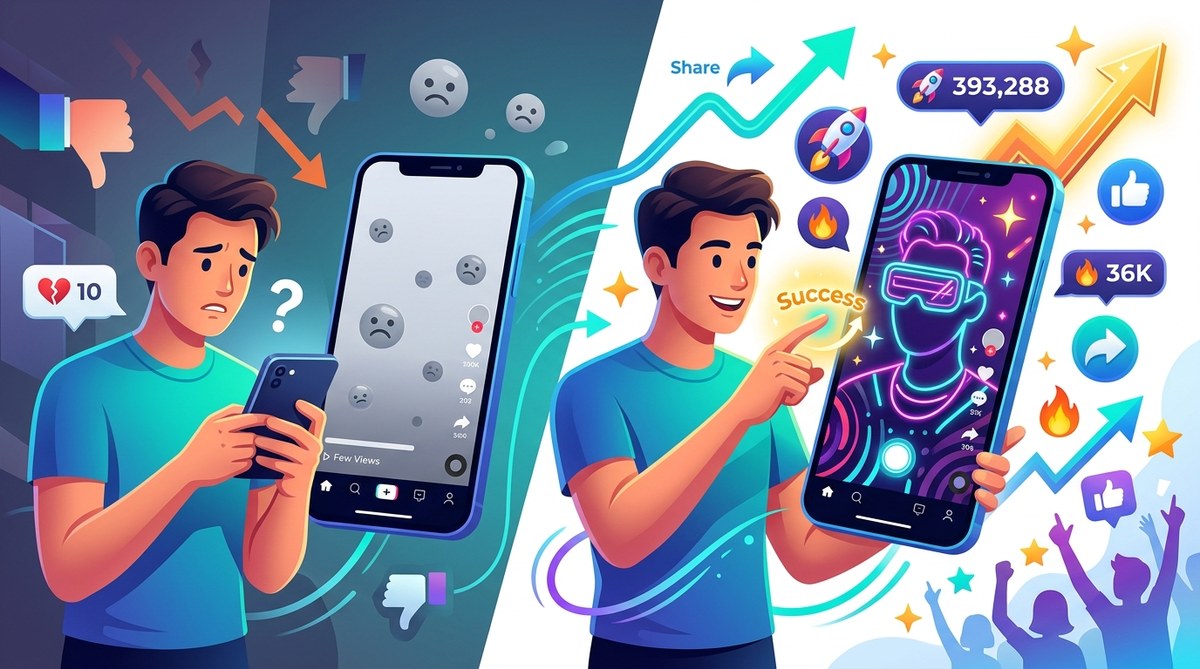
You post a TikTok. You wait. You refresh. Nothing happens.
Your view count sits at 200 while someone else’s mediocre dance routine hits 2 million. It stings. You’re putting in the effort, but the algorithm seems to have blacklisted your account. The truth is, going viral on TikTok isn’t random luck. It’s a formula. And most creators are missing half the ingredients.
TikTok videos fail to go viral because of poor hook timing, weak engagement signals, mismatched content trends, and low production quality. Success requires understanding the algorithm’s preference for watch time, strategic posting schedules, trend participation within 48 hours, and creating interactive effects that encourage user participation. Custom AR effects boost engagement by 340% compared to standard videos.
The algorithm doesn’t hate you, it just doesn’t understand you
TikTok’s recommendation system works differently than you think.
It doesn’t care about your follower count. It cares about completion rate. If viewers scroll past your video in two seconds, the algorithm assumes it’s boring. Your content dies before it ever reaches the For You page.
The first three seconds matter more than the next 27 combined.
Your hook needs to stop the scroll. Not with clickbait. With genuine curiosity or immediate value. “Watch what happens when I…” beats “Hey guys, today I’m gonna…” every single time.
Here’s what the algorithm actually tracks:
- Average watch time percentage
- Completion rate (did they watch to the end?)
- Rewatches (did they loop it?)
- Shares (did they send it to friends?)
- Comments (did they engage?)
- Profile visits after viewing
Each metric tells TikTok whether your content deserves a bigger audience. If your video gets 200 views and 150 people watch all the way through, that’s a 75% completion rate. TikTok will test it on a larger batch. If that batch also watches through, you’re on your way to viral.
But if your completion rate sits at 20%? The algorithm cuts your distribution immediately.
Timing kills more videos than bad content
You could create the perfect video and still get zero traction if you post at 3 AM when your audience is asleep.
TikTok’s algorithm gives every video an initial test batch of 200 to 500 viewers. If those viewers don’t engage, your video flatlines. The problem? That test batch comes from people currently active on the app.
Post when your audience is scrolling.
For most creators in the US, that means:
- 7 AM to 9 AM (morning commute and breakfast scrolling)
- 12 PM to 1 PM (lunch break browsing)
- 7 PM to 11 PM (evening relaxation time)
But don’t just copy these times. Check your TikTok analytics. Go to your profile, tap the three lines, select Creator Tools, then Analytics. Scroll to Followers and look at “Follower activity.” It shows exactly when your audience is online.
Post 30 minutes before peak activity. Your video will be fresh when the crowd arrives.
Your content is too polished or not polished enough
TikTok users smell overproduced content from a mile away.
If your video looks like a TV commercial, it feels like an ad. People skip ads. But if your video looks like you filmed it on a potato from 2008, they assume you don’t care about quality.
The sweet spot? Authentic but intentional.
Good lighting matters. You don’t need a ring light, but film near a window during daytime. Natural light makes everything look better.
Clear audio matters. TikTok users will forgive shaky footage, but they won’t tolerate audio that sounds like you’re recording inside a wind tunnel. Use your phone’s built-in mic in a quiet room, or grab a $20 lavalier mic.
Editing matters. Jump cuts keep energy high. Transitions maintain interest. Text overlays clarify your point. But don’t overdo it. One transition effect per video is plenty.
Here’s a comparison table of what works versus what doesn’t:
| What Works | What Doesn’t Work |
|---|---|
| Natural lighting from windows | Harsh overhead fluorescent lights |
| Clear audio in quiet spaces | Echo-filled room recordings |
| Simple jump cuts | 47 different transition effects |
| Text that adds context | Text that just repeats what you’re saying |
| Authentic reactions | Overly scripted performances |
| Vertical 9:16 format | Horizontal video with black bars |
You’re chasing trends three weeks too late
By the time you see a trend everywhere, it’s already dying.
TikTok trends have a lifespan of 48 to 72 hours at peak virality. After that, the algorithm deprioritizes them because it wants fresh content. If you hop on a trend a week late, you’re competing with thousands of similar videos that already got traction.
The solution? Catch trends early.
Follow trend-tracking accounts that spot emerging sounds and formats before they explode. When you see a sound with 5,000 uses instead of 5 million, that’s your window. Create your version immediately.
Better yet, create your own trends using custom AR effects.
How to make TikTok effects that actually get used by thousands is possible even if you’ve never touched design software. Effect House, TikTok’s AR creation platform, offers templates that let you build interactive filters in under an hour.
Why does this matter for virality? Because custom effects generate 340% more engagement than standard videos. Users want to try the effect themselves. They duet your video. They share it. Each interaction signals to the algorithm that your content is valuable.
“The creators who go viral consistently aren’t the ones with the best production value. They’re the ones who understand engagement loops. Every video should encourage a specific action: comment, share, duet, or use your effect.” – TikTok Creator Fund recipient, 4.2M followers
Your captions and hashtags are working against you
Most creators treat captions as an afterthought. That’s a mistake.
Your caption is searchable. TikTok’s search function is becoming more like Google every day. If someone searches “why my TikTok not going viral,” and your caption contains those exact words, you have a better chance of appearing in results.
Write captions that include:
- The main topic (searchable keywords)
- A question or hook that encourages comments
- A call to action (follow for part 2, share with someone who needs this)
Keep it under 150 characters. Longer captions get cut off, and users won’t tap “more” unless they’re already hooked.
Hashtags still matter, but not the way you think. Don’t use #fyp or #foryoupage. Everyone uses them, so they’re meaningless. Instead, use:
- One broad hashtag (#tiktoktips)
- Two specific hashtags (#tiktokeffecttutorial #arfilters)
- One niche hashtag (#effecthousecreators)
This strategy helps TikTok categorize your content while reaching people genuinely interested in your topic. If you’re creating AR effects, complete beginner’s roadmap to publishing your first TikTok effect covers the entire process from concept to publication.
You’re not giving people a reason to engage
Engagement is currency on TikTok.
Every comment, share, and save tells the algorithm your video is worth promoting. But most creators post videos that are complete thoughts. There’s nothing left to discuss. No reason to comment.
Change that.
End your videos with open questions. “What would you do in this situation?” or “Have you experienced this?” or “Which version do you prefer?”
Create content with intentional mistakes. Yes, seriously. A small, noticeable error (like calling something by the wrong name) triggers comments from people eager to correct you. Each correction boosts your engagement metrics.
Use interactive effects that require participation. Face filters that react to expressions, games that challenge users to beat a score, or effects that reveal different results each time. These formats naturally generate duets and stitches.
The 7 viral TikTok effect trends you can build in Effect House this month guide shows exactly which interactive formats are trending right now. Building one takes less time than filming 20 regular videos that go nowhere.
Your profile is a ghost town
People check your profile before following you. If they see three videos from six months ago, they assume you quit. No follow.
Consistency signals commitment.
You don’t need to post five times a day. But you do need a schedule. Three videos per week is enough if they’re strategic. The algorithm rewards accounts that post regularly because it knows you’ll keep feeding the platform with content.
Batch create your videos. Spend two hours on Sunday filming and editing six videos. Schedule them throughout the week. This approach removes the daily pressure while maintaining consistency.
Your bio matters too. It should clearly state what you create and why someone should follow. “I teach people how to create AR filters” is better than “Living my best life ✨🌟.”
Add a profile link. If you’re monetizing your skills, monetizing your TikTok AR skills without a massive following explains how to turn 1,000 engaged followers into paying clients.
The technical stuff you’re probably ignoring
TikTok’s technical requirements affect distribution more than most creators realize.
Upload in the highest quality possible. Go to Settings > Data Saver and turn off “Data Saver mode.” Then enable “Upload HD” in your TikTok settings. Higher quality videos get prioritized in recommendations.
Film in vertical format. Always. Horizontal videos with black bars on the sides get lower distribution because they don’t fill the screen. Users scroll past them faster.
Use trending sounds correctly. Don’t just slap a trending audio over unrelated content. The audio should match your video’s energy and context. Mismatched audio feels jarring and increases scroll-past rates.
Check your video length. TikTok favors videos between 21 and 34 seconds for the For You page. Longer videos can work, but they need exceptional retention to compete. Shorter videos often don’t provide enough value to generate engagement.
Here’s a technical checklist before posting:
- Video is 9:16 vertical format
- Resolution is at least 1080p
- Audio is clear and balanced
- Trending sound is used appropriately
- Length is between 21-34 seconds
- Captions are enabled for accessibility
- Upload HD is enabled in settings
Platform-specific effects give you an unfair advantage
Creating custom AR effects for TikTok isn’t just about standing out. It’s about creating content that promotes itself.
When you publish an effect through Effect House, it gets its own page on TikTok. Anyone who uses your effect automatically links back to you as the creator. Every video made with your effect is free promotion.
This creates a compounding growth loop:
- You create an effect
- Users discover it and create videos
- Their videos promote your effect
- More users find your effect
- Your follower count grows
- Your main content gets more initial views
The effect House vs Spark AR comparison breaks down why TikTok’s native platform gives you better reach than cross-posting effects from other platforms. TikTok prioritizes native content over imported content every time.
You don’t need coding skills to start. Effect House templates handle the technical work. You just customize colors, add your branding, and adjust the interaction triggers. Advanced Effect House techniques for interactive games and challenges shows how to take basic templates and turn them into viral sensations.
Your audience isn’t who you think it is
Most creators make content for themselves instead of their audience.
You might love 60-second educational deep dives, but your audience might prefer 15-second entertainment. Check your analytics to see which videos actually performed well. What do they have in common?
Look at:
- Average watch time (which videos kept people watching?)
- Traffic source (are people finding you through For You or Following?)
- Audience territories (where are your viewers located?)
- Audience gender and age (who’s actually watching?)
Adjust your content strategy based on data, not assumptions. If your 15-second comedy sketches get 10x more views than your 45-second tutorials, make more sketches. You can always add educational value in a fun format.
Test different content types systematically. Post one educational video, one entertainment video, and one trend-based video each week. Track which category performs best. Double down on winners.
The real reason you’re not going viral yet
You’re treating TikTok like a one-way broadcast instead of a conversation.
Viral content creates community. It makes people feel seen, heard, or understood. It invites participation. It sparks discussion. Your job isn’t to perform at your audience. It’s to create with them.
Respond to every comment in your first hour after posting. This signals active engagement to the algorithm and encourages more people to comment. Ask follow-up questions. Start conversations.
Duet and stitch other creators’ content. This introduces you to their audience and shows you’re part of the community, not just broadcasting into the void.
Create content that solves specific problems. “How to fix low TikTok views” performs better than “TikTok tips” because it addresses a specific pain point. People searching for solutions will find your content through TikTok’s search function.
Use AR effects strategically. A face filter that changes based on user expressions creates natural interaction. A game effect that challenges users to beat a score generates competitive duets. These formats turn passive viewers into active participants.
The 5 common mistakes every AR beginner makes guide helps you avoid the pitfalls that tank most first-time effect creators. Your first effect doesn’t need to be perfect. It needs to be published.
Building momentum instead of chasing virality
Here’s the uncomfortable truth: most viral videos are flukes. They don’t build sustainable growth.
A single viral video might bring 100,000 views. But if your next video gets 300 views, the algorithm assumes the viral one was an anomaly. Your account doesn’t grow.
Sustainable growth comes from consistent performance. Ten videos that each get 5,000 views build more momentum than one video with 50,000 views and nine videos with 200 views.
Focus on your baseline. What’s your average view count? Work to increase that average by 20% each month. Improve your hooks. Tighten your editing. Test new formats. Each small improvement compounds.
Track your metrics in a simple spreadsheet:
- Date posted
- Video topic
- View count after 24 hours
- Completion rate
- Engagement rate (comments + shares / views)
- Traffic source
Patterns will emerge. Maybe videos posted at 8 AM consistently outperform 8 PM posts. Maybe tutorial content gets higher completion rates than vlogs. Use this data to inform your strategy.
Your next video should be different
You now know why your TikTok isn’t going viral. The question is what you’ll do about it.
Start with one change. Not ten. Pick the easiest fix from this guide and implement it in your next video. Maybe that’s posting at a better time. Maybe it’s adding a question to your caption. Maybe it’s trying a trending sound within 48 hours instead of 48 days.
Test. Measure. Adjust.
If you’re ready to create content that stands out, consider building your first AR effect. The learning curve is shorter than you think, and the payoff is massive. Users actively seek out new effects to try. Your effect becomes a discovery tool that brings viewers to your profile automatically.
The creators who succeed on TikTok aren’t the ones with the most talent or the biggest budgets. They’re the ones who understand the platform’s mechanics and create accordingly. You’ve got the knowledge now. Time to put it to work.