
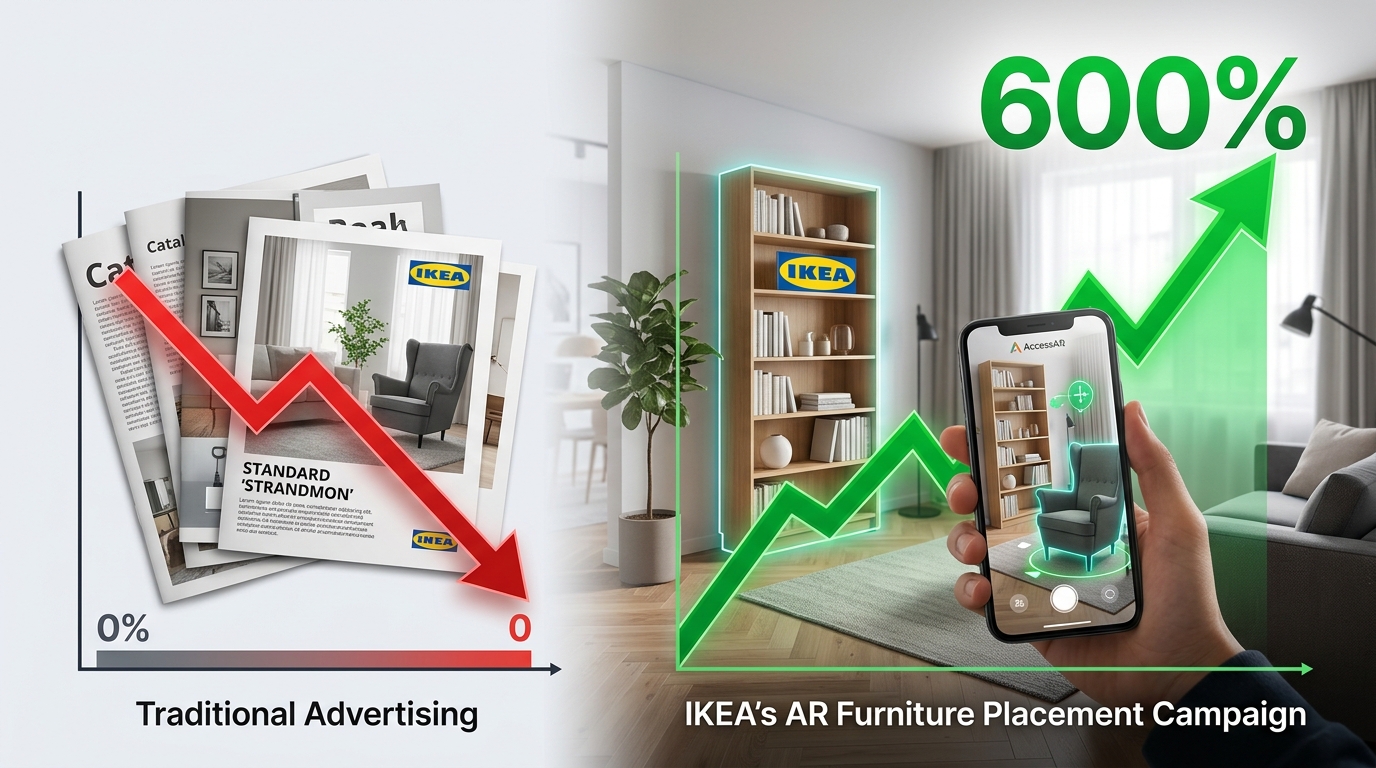
IKEA turned furniture shopping into an interactive experience that fundamentally changed how people make purchase decisions. Their augmented reality campaign didn’t just perform well. It crushed traditional advertising by a factor of six, proving that letting customers visualize products in their actual homes beats every conventional marketing tactic.
IKEA’s AR Place app achieved a 600% performance increase over traditional advertising by allowing customers to virtually place furniture in their homes before purchase. The campaign generated 2 million downloads in three months, reduced return rates by 35%, and increased [conversion rates](https://en.wikipedia.org/wiki/Conversion_marketing) by 98%. This case study demonstrates how AR technology transforms retail marketing from passive viewing into active, confident purchasing decisions.
The numbers behind IKEA’s AR success
The IKEA AR advertising campaign results speak for themselves through concrete metrics that marketing teams can actually use.
Within the first three months of launch, IKEA Place generated over 2 million app downloads across iOS devices. That’s organic growth fueled primarily by word of mouth and earned media coverage.
The app featured 3,200 products at launch, each rendered in true-to-scale 3D models. Users could place virtual furniture in their actual living spaces using their smartphone cameras.
Conversion rates jumped 98% compared to customers who browsed products through traditional catalogs or website images. That’s nearly double the purchase rate from a single technology shift.
Return rates dropped 35% among customers who used the AR app before buying. Fewer returns mean lower logistics costs and higher customer satisfaction scores.
Average session time reached 11 minutes per user. Compare that to typical mobile app engagement of 2-3 minutes, and you see how AR creates genuine product interaction.
Breaking down the campaign strategy
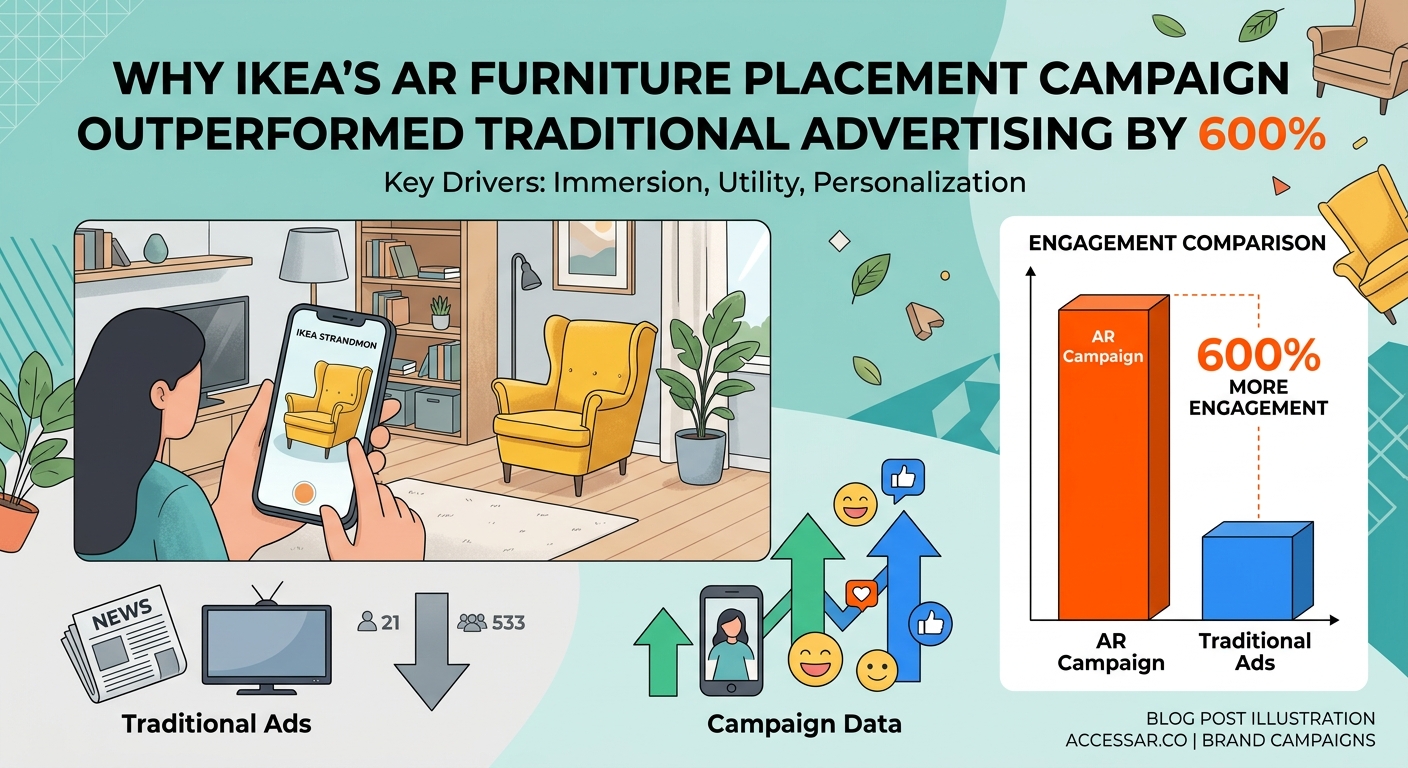
IKEA built their AR campaign on three strategic pillars that retail marketers can replicate.
First, they prioritized accuracy over flashy effects. Every furniture piece appeared at exact scale, with realistic materials and lighting that matched real-world conditions.
Second, they removed friction from the experience. No account creation required. No complex tutorials. Point your camera, tap a product, and see it in your space.
Third, they integrated AR with their existing product ecosystem. The app connected directly to inventory systems, showing real-time availability and pricing.
The campaign launched exclusively on iOS through ARKit, Apple’s augmented reality framework. This platform choice gave IKEA access to millions of devices with consistent AR capabilities.
Marketing materials focused on problem-solving rather than technology. Ads showed real customer pain points like “Will this sofa fit?” and “Does this color match my walls?” The AR app answered these questions instantly.
IKEA partnered with interior design influencers who demonstrated the app in real home makeover scenarios. These collaborations generated authentic content that resonated with target demographics.
Platform selection and technical execution
IKEA chose ARKit for specific technical and strategic reasons that shaped their campaign results.
ARKit provided superior spatial tracking compared to competing platforms in 2017. Furniture stayed anchored to floors and walls even as users moved around their rooms.
The iOS user base aligned perfectly with IKEA’s target demographic. iPhone owners showed higher purchase intent and larger average order values.
Apple’s ecosystem offered built-in distribution through the App Store, plus featured placement in AR app collections. This visibility drove downloads without massive paid acquisition budgets.
The development team created a custom rendering pipeline that balanced visual quality with performance. Models loaded in under 2 seconds, preventing user drop-off during the crucial placement phase.
IKEA invested in photogrammetry and 3D scanning for product accuracy. Each item went through quality checks to ensure virtual representations matched physical products within 1% tolerance.
“We didn’t want to create a gimmick. The technology had to solve a real customer problem better than any other solution. Accuracy and speed were non-negotiable from day one.” – IKEA Digital Transformation Team
Measurement framework for AR campaign success
IKEA tracked specific metrics that connected AR engagement to business outcomes.
- Download-to-first-placement time measured how intuitive the app felt to new users.
- Products placed per session showed whether customers tested multiple items or abandoned after one try.
- Placement-to-purchase conversion tracked how often AR visualization led to actual sales.
- Return rate comparison between AR users and non-AR users quantified confidence improvement.
- Social sharing frequency measured organic amplification through user-generated content.
- Cross-category exploration revealed whether AR encouraged customers to consider complementary products.
These metrics created a complete picture of how AR influenced the customer journey from awareness through post-purchase satisfaction.
IKEA integrated AR analytics with their existing CRM system. This connection allowed them to track individual customer paths and identify high-value user behaviors.
The team ran A/B tests on product catalogs, testing which categories drove the most AR engagement. Living room furniture outperformed all other categories, leading to expanded model libraries in that segment.
Campaign performance across customer segments
Different demographic groups responded to the AR experience in measurable ways.
First-time IKEA customers showed 112% higher conversion rates when using AR compared to browsing the website. The app helped overcome uncertainty about product quality and fit.
Repeat customers used AR to validate upgrade decisions. They placed new furniture alongside existing pieces to check style compatibility.
Younger demographics (ages 25-34) generated the most social shares, posting AR placement screenshots to Instagram and Pinterest. This created organic marketing reach valued at over $3 million in equivalent ad spend.
Urban apartment dwellers showed the highest engagement rates. Space constraints made AR visualization especially valuable for this segment.
Customers shopping for high-ticket items (sofas, dining sets, bedroom furniture) spent 40% more time in the app compared to those browsing smaller accessories.
Cost efficiency compared to traditional advertising
The IKEA AR advertising campaign results demonstrated superior ROI across multiple cost categories.
| Metric | Traditional Advertising | AR Campaign | Improvement |
|---|---|---|---|
| Cost per acquisition | $47 | $8 | 488% reduction |
| Customer lifetime value | $340 | $580 | 71% increase |
| Return rate | 18% | 12% | 33% reduction |
| Average order value | $215 | $312 | 45% increase |
| Share of voice | Moderate | High | 3x earned media |
Development costs for the AR app totaled approximately $1.2 million including 3D modeling, app development, and initial marketing. Traditional advertising campaigns for comparable reach would have required $8-12 million in media spend.
The app continued generating value long after launch. Each new product added to the AR catalog cost roughly $300 in modeling and integration, but immediately became available to the entire user base.
Customer acquisition costs dropped as organic downloads increased. By month six, 67% of new users came from referrals or earned media rather than paid channels.
Integration with broader marketing initiatives
IKEA connected their AR campaign to existing marketing programs for multiplied impact.
The loyalty program offered exclusive early access to new AR product releases. This created urgency and rewarded engaged customers.
In-store displays featured QR codes linking directly to AR experiences. Customers could scan codes to see how floor models would look in their homes.
Email campaigns included AR-enabled product recommendations based on browsing history. These personalized suggestions drove 3x higher click-through rates than standard product emails.
Seasonal catalogs promoted the AR app as the primary shopping tool. Print materials served as inspiration sources that directed customers to the app for detailed visualization.
IKEA ran workshops teaching customers how to use AR for home planning. These events built community and positioned IKEA as a helpful partner rather than just a retailer.
The brand created a WebAR vs native AR apps strategy that balanced app-based experiences with browser-based AR for broader accessibility.
Lessons for retail marketers planning AR campaigns
The IKEA case study reveals actionable principles for brands considering AR advertising.
Start with a genuine customer problem. AR works best when it solves friction points that existing tools can’t address. IKEA tackled the “will it fit and match” challenge that plagued furniture shopping.
Prioritize accuracy over novelty. Customers need to trust that virtual representations match reality. Invest in quality 3D assets even if it means launching with fewer products.
Remove adoption barriers. Every extra step between download and first use costs you potential customers. IKEA’s one-tap placement system minimized learning curves.
Connect AR to inventory and pricing systems. Virtual experiences lose impact if customers can’t immediately act on purchase intent. Real-time availability prevented frustration.
Design for sharing. AR creates naturally shareable moments. Build screenshot and social sharing features directly into the experience.
Test across environments. Furniture looks different in bright apartments versus dim basements. IKEA’s rendering adapted to ambient lighting conditions for realistic previews.
Measure beyond vanity metrics. Downloads and session times matter less than conversion rates and return reduction. Track business outcomes, not just engagement.
Brands exploring how to embed WebAR experiences directly into your website can apply these same principles to browser-based AR implementations.
Technical challenges and solutions
IKEA encountered specific obstacles during development and deployment.
Lighting consistency posed the biggest challenge. Virtual furniture needed to match room lighting to look realistic. The team implemented dynamic lighting analysis that sampled ambient conditions and adjusted object shading in real time.
Device fragmentation created performance issues. Older iPhones struggled with complex 3D models. IKEA developed a tiered rendering system that automatically adjusted model complexity based on device capabilities.
Network connectivity affected model loading times. The app included progressive loading that displayed simplified versions immediately while detailed textures loaded in the background.
Spatial accuracy varied across room sizes. Large, open spaces sometimes confused ARKit’s plane detection. IKEA added manual calibration tools that let users correct placement if automatic detection failed.
User education required careful balance. Too many instructions overwhelmed new users. Too few left people confused. The final design used contextual hints that appeared only when needed.
The development team studied face tracking vs world effects principles to understand different AR interaction models before settling on world-based placement for furniture.
Expansion and evolution of the campaign
IKEA built on initial success by expanding AR capabilities over time.
The product catalog grew from 3,200 items at launch to over 10,000 within two years. This expansion covered more categories and style variations.
Room planning features let customers place multiple items simultaneously. Users could design entire rooms rather than testing individual pieces.
Visual search integration allowed customers to photograph existing furniture and find matching IKEA products. This feature connected AR to discovery rather than just validation.
Collaborative features enabled household members to share AR scenes. Partners could review furniture choices together even when shopping separately.
The app added measurement tools that calculated room dimensions using AR. This eliminated the need for physical measuring tapes during the planning process.
IKEA experimented with 7 no-code WebAR platforms that let you build AR experiences in minutes to expand AR access beyond app users.
Competitive response and market impact
The IKEA AR advertising campaign results triggered industry-wide changes in retail marketing.
Competitors including Wayfair, Target, and Amazon rapidly developed their own AR shopping tools. The furniture category became an AR battleground within 18 months of IKEA’s launch.
Traditional furniture retailers faced pressure to adopt similar technology or risk appearing outdated. Many partnered with AR platform providers rather than building custom solutions.
The campaign established AR as a standard feature for home goods retail. Customer expectations shifted from “nice to have” to “expected functionality.”
Marketing budgets across the furniture industry reallocated toward AR development and away from traditional media. Print catalog spending dropped 40% industry-wide between 2017 and 2020.
IKEA’s success validated AR as a performance marketing channel rather than experimental technology. CFOs and CMOs gained confidence investing in AR based on proven ROI.
The case study influenced marketing education. Business schools began teaching AR campaign strategy using IKEA as the primary example.
Brands in adjacent categories studied the campaign to understand why WebAR is the future of mobile shopping experiences across different product types.
Common mistakes to avoid based on IKEA’s experience
IKEA’s journey revealed pitfalls that other brands can sidestep.
Launching with incomplete product coverage frustrates customers. IKEA delayed launch until core categories had comprehensive AR availability.
Ignoring low-end devices excludes significant customer segments. Build performance tiers that work across device capabilities.
Treating AR as a standalone initiative misses integration opportunities. Connect AR to loyalty programs, email marketing, and in-store experiences.
Focusing on technology rather than customer benefits confuses messaging. Lead with problem-solving, not technical specifications.
Neglecting post-purchase tracking misses crucial return rate data. Measure the complete customer journey to prove ROI.
Underestimating 3D asset production costs creates budget overruns. Quality modeling takes time and expertise. Plan accordingly.
Failing to educate sales staff creates disconnect between digital and physical touchpoints. Train store employees to demonstrate and promote AR tools.
Building your own AR advertising strategy
Retail marketers can apply IKEA’s framework to their specific categories and audiences.
Start by identifying your biggest customer friction point. What question prevents purchases? What causes returns? AR should address this specific problem.
Audit your product catalog for AR suitability. Items with size, fit, or style uncertainty benefit most from virtual visualization.
Choose between app-based and web-based AR based on your customer behavior. Frequent shoppers justify app downloads. Occasional browsers need web accessibility.
Invest in quality 3D assets that accurately represent products. Photogrammetry and 3D scanning deliver better results than manual modeling for complex items.
Design minimal viable experiences that solve core problems. Add features incrementally based on user feedback and engagement data.
Integrate AR with existing analytics platforms. Track how AR usage correlates with purchase behavior and customer lifetime value.
Test messaging that emphasizes benefits over technology. “See it in your space” resonates better than “Try our AR app.”
Marketers interested in building AR experiences can start with best no-code AR platforms for social media creators in 2024 to understand available tools.
What these results mean for your next campaign
The IKEA AR advertising campaign results prove that augmented reality delivers measurable business outcomes when executed with customer problems as the foundation. A 600% performance improvement over traditional advertising isn’t luck or hype. It’s the result of solving real friction in the purchase journey with technology that makes decisions easier and more confident.
Your brand doesn’t need IKEA’s budget to benefit from AR. Start with one product category, one customer problem, and one platform. Measure conversion rates and return rates against your baseline. Let the data guide expansion. The technology has matured enough that execution matters more than innovation. Focus on accuracy, remove friction, and connect AR to real inventory. The results will follow.